
Expert Perspectives
70% Are Just Clocking In: The Hidden Cost of a Workforce That Doesn't Feel Heard
Empathy isn't a soft virtue. It's a trainable skill with a measurable return, and here is how to start leveraging it.
Insights drawn from the work of Mimi Nicklin
Published October 7, 2026
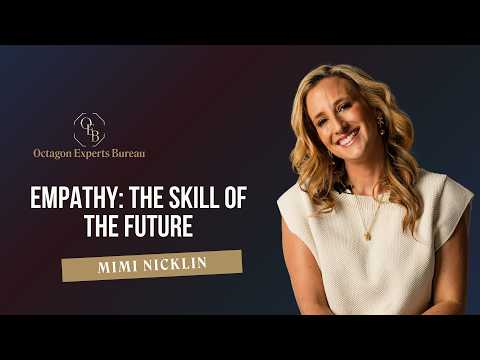
In the United States, only about 28 percent of the workforce is engaged. In the United Kingdom, the figure drops to around 9 percent. Whether you lead ten people or ten thousand, the math is the same: most of your team arrives, completes the task in front of them, and goes home. They are not innovating. They are not volunteering the idea that would save you a quarter's worth of rework. They are doing what they are told, and nothing more.
That gap has a price tag. Gallup and the World Bank estimate the global loss from disconnection and disengagement at roughly $9 trillion in productivity and profit. If your numbers are slipping and you keep blaming laziness, it may be worth asking a different question: when did anyone last feel genuinely heard here?
Why "Soft Skill" Is The Wrong Label
Empathy is the ability to take the perspective of someone else, to understand why a person in the same room, with the same facts, sees the situation differently than you do. It lives in the prefrontal cortex, and everyone has the same amount of the underlying capacity. What varies is practice.
That is why it belongs in the hard-skills column. It is hard to master, it requires repetition, and it moves hard numbers. Research on empathetic workplaces points to meaningfully higher profit, engagement and output, plus lower turnover, absenteeism and sick leave. The market is already pricing this in. EY recently announced $100 million in bonuses for human skills alone: emotional intelligence, empathy, communication, collaboration and flexibility. When a Big Four firm funds it at that scale, it has stopped being a retreat topic and become a capital allocation decision.
Listen First, Because Safety Starts There
Psychological safety may have cooled as a buzzword, but the underlying reality hasn't changed. You cannot create safety for people if you don't know what safety means to them, and you cannot learn that without listening.
The test is simple. Imagine a dinner where the other person never asks you a single question. By the end, you have shared nothing. Your team runs the same experiment every day. If leaders don't listen, people stop offering anything worth hearing, and the cost shows up later as risk, bad decisions and surprises you should have seen coming.
This isn't about being nice. It's about gathering human data. Organizations with higher trust tend to have higher profit, and trust is built in the small moments where someone speaks and is actually received.
Acknowledge Before You Act
Most leaders are trained to fix things. A problem is raised, so we move to solve it. But people often don't need the fix. They need to know the problem registered. Something like "That sounds really hard" costs nothing and does more for safety than a hurried action plan. Acknowledgement over action is a counterintuitive discipline for fast-moving cultures, and it may be the highest-leverage one.
One practical way to organize this is through A.L.U.R. a Listening Led Leadership Framework.
Authentic Presence: make eye contact. In busy cities and busy offices, people barely look at each other. If direct eye contact feels intense, look at the bridge of someone's nose. Most people can't tell the difference.
Listening: ask open-ended questions. "Can you tell me more about that?" or Help me understand why that matters invites the other person to go deeper instead of shutting the exchange down with a yes or no.
Understanding: use confirm or correct. When someone finishes, reflect back what you heard: What I heard is that you'll be late and want to start Thursday. They either confirm it or correct it. Either way, they feel heard, and you catch the gap between what was said and what you assumed.
Recognition: name the experience. That sounds like it was a really awkward conversation shows you registered the weight of what they shared, not just the content.
None of this is complicated. These actions are simple but not easy, because they require intention and repetition.
Understanding Is Not Agreeing
Multigenerational teams are where empathy gets tested hardest. The key distinction is that empathy asks you to understand, not to agree or judge. You don't have to love Snapchat to grasp why it matters to a colleague. And it runs in every direction: younger employees owe their managers the same effort. If your boss hates emoji replies, stop sending them.
AI Makes This More Urgent, Not Less
Much of the fear around AI comes from speed. Change reads as risk, and risk triggers survival instincts. When nobody explains what it means for them, people fill the silence with worst cases. The organizations that thrive will be the ones whose people move through disruption together, and that cohesion runs on conversation and trust. How your people use AI, not whether you buy it, will separate the expensive experiments from the real returns.
What To Measure
Behavior change takes longer than six months to show up cleanly, but you can track the right levers: belonging, psychological safety, willingness to speak up, confidence taking risks, motivation. These are the conditions that precede innovation and growth, and what you measure is what you will actually manage.
*
This piece draws on the work of Mimi Nicklin, an empathy advocate and bestselling author who helps leaders turn listening into a practical performance capability through her Listening-Led Leadership work and A.L.U.R. framework. She speaks and trains globally on emotional intelligence, human skills and connection in the age of AI.
Want Mimi for your next event, conference, or training?
Book Mimi Nicklin →